Welcome to Uncharted
Behind every artist, writer, and dreamer lies a terrain of risks and discoveries that can’t be plotted in advance. To create is to wander into the unknown, guided less by certainty than by curiosity. Each guest is asked the same ten questions, but their answers reveal something far greater—an unfiltered glimpse into the raw and deeply personal terrain of a creative life.
Created by Connor Wolfe (they/them), founder of Wayfarer Books and Wayfarer Magazine, “Uncharted” is an invitation to step off the map and explore what it means to live and create beyond the expected.
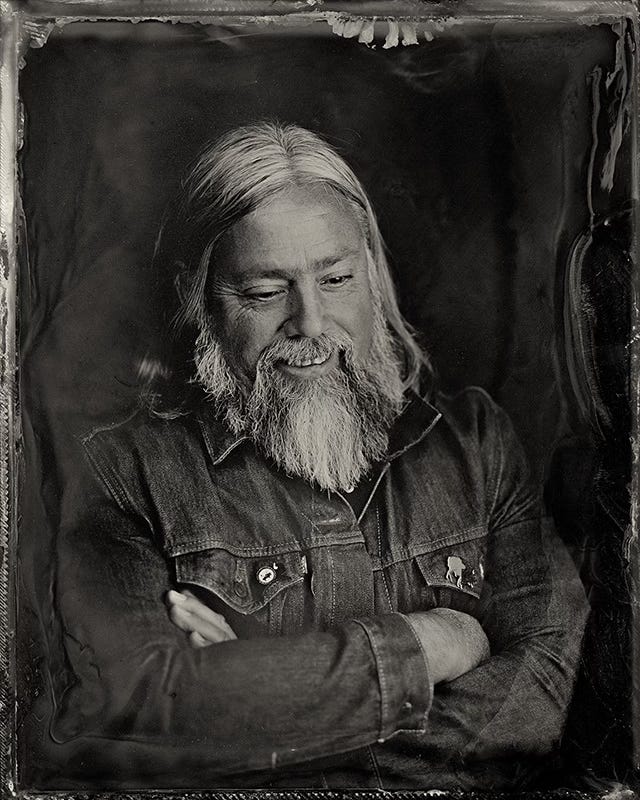
Uncharted with Chris La Tray
On Round Dances, Resistance, and the Night Sky as Guide
Issue 43. October 2025
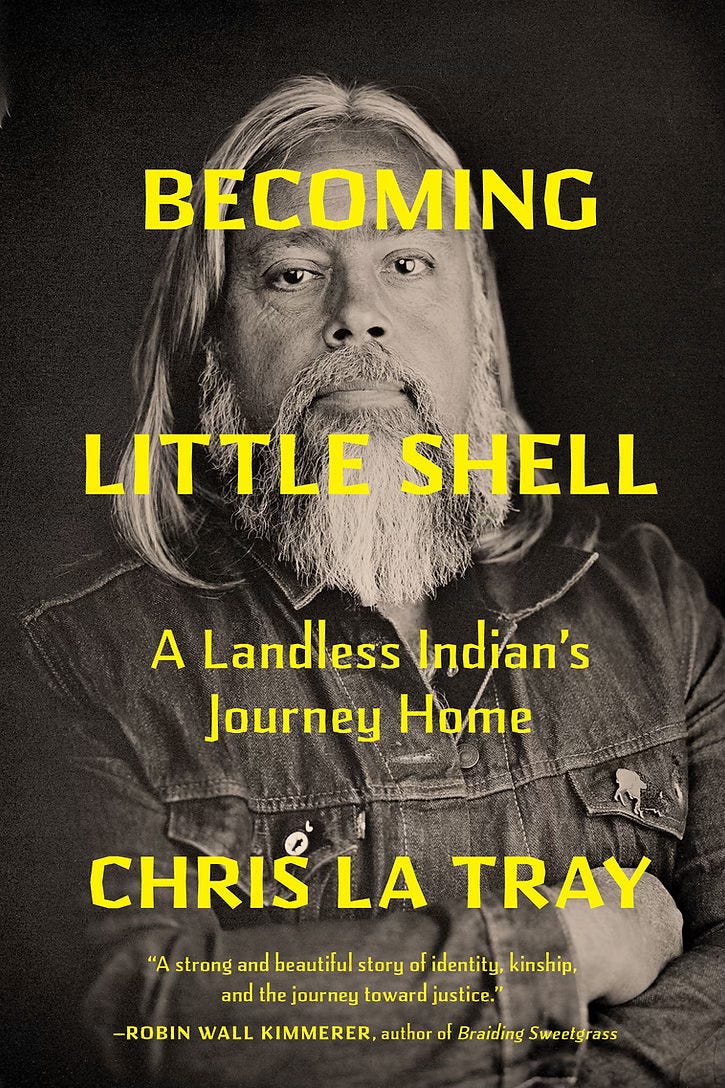
Chris La Tray is a Métis storyteller, descended from the Pembina Band of the mighty Red River of the North and a citizen of the Little Shell Tribe of Chippewa Indians. His most recent book, Becoming Little Shell: A Landless Indian’s Journey Home (Milkweed Editions, 2024), has been widely acclaimed, earning the Pacific Northwest Book Award, the Writing the West Award, and recognition as Best Memoir of the Year by both People and Esquire.
His debut, One-Sentence Journal: Short Poems and Essays from the World at Large, won the 2018 Montana Book Award and a 2019 High Plains Book Award. He followed that with a collection of haiku and haibun poetry, Descended from a Travel-worn Satchel (2021).
In addition to his books, Chris has served as the 2025 Kittredge Distinguished Visiting Writer at the University of Montana and received the 2025 Montana Heritage Keeper Award from the Montana Historical Society. He also writes the weekly newsletter An Irritable Métis.
Chris lives near Frenchtown, Montana, and was honored to serve as Montana’s 11th Poet Laureate from 2023 to 2025.
1. What’s lighting you up creatively right now?
Reminding people that what we are seeing from our political leaders isn’t an anomaly, it’s the system operating as it’s always been designed to. I think marginalized people understand this because we have had lifetimes of looking over our shoulders but for stunned white, middle class and higher folks—people who never thought they would be touched directly by the shittier aspects of our society—it’s something of a moment. It sucks, yeah, but also, what a time for them to actually see the plights of people they have lived side-by-side with but never really saw before. I thought Covid would provide that shakeup but it really hasn’t; the status quo returned to business as usual far quicker than I thought it would. Maybe now is the time meaningful societal change moves beyond lip service, but who can say. Convenience is a heady intoxicant. But creative people bear some responsibility to keep what many may see as radical ideas front and center and I’m here for it.
2. What’s the last thing that truly captivated you—an idea, a place, a piece of art, a poem, a moment?
Last spring I was invited to attend a round dance at my tribe’s cultural center. The organizer invited drummers from all over the region—Blackfeet, Cree, Dakota and Nakoda—and when it started, there was a large circle of fourteen young men with hand drums all singing and playing together. The volume and the energy was absolutely thrilling and transcendent. I felt it in every fiber of my body.
3. What’s a recent experience that made you feel deeply present?
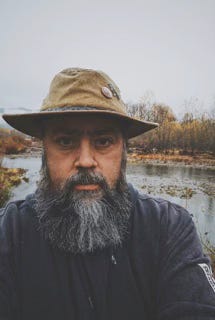
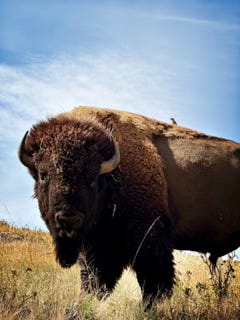
I was driving through the Bison Range on the CSKT Reservation and had to stop for a buffalo—or bizhiki, in Anishinaabemowin—jam. There was a large bull standing on a low rise right next to the road, maybe two arm’s lengths away from where I had to coast to a stop. This was early August, deep into the rut, so his tongue was hanging out, and he was breathing hard and grunting, and we just looked at each other face to face, dark eyes to dark eyes. He wasn’t showing any signs otherwise of aggression, just interest, and I felt our shared gaze was happening across many swirls of time. It doesn’t take much for me to be moved by this older-than-human relative, and this was a particularly profound experience.
4. What’s a piece of art, a book, or a conversation that’s been living in your mind rent-free?
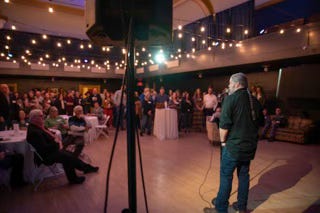
Any of the work by Leanne Betasamosake Simpson, whose most recent book is called, Theory of Water: Nishnaabe Maps to the Times Ahead. Leanne is a Michi Saagiig Nishnaabeg person of many, many talents, and the boldest of revolutionaries. I’m a deep admirer of her. Next year is the 250th anniversary of the United States, you know, and a couple of my comrades and I are planning to organize a follow-up to an Indigenous storytelling festival called IndigiPalooza MT we just survived with one dedicated to the idea of 250 Years of Resistance… and Counting. I’m hoping to convince Simpson of the worthiness of joining us, even if she is Canadian. After all, we didn’t cross the border, the border crossed us!
5. What’s the most rebellious thing you’ve ever done in your creative work?
Saying no to things I don’t want to do. As artists we spend too many years living in scarcity mindset where we are too easily coerced into saying yes to invitations that don’t serve us. Saying no to things that seem like no brainers to say yes to, even tiny little things, can be a powerful form of resistance when our survival depends on changing the game.
6. If your younger self could see you now, what would surprise them the most? What would disappoint them?
My younger self would be shocked that I ever really started writing poetry, let alone served as the state’s poet laureate. As for disappointment? That I still haven’t seen Judas Priest live.
7. What is a truth you’ve had to unlearn in order to grow?
That when push comes to shove people will do the “right” thing. Just look at what is happening in Gaza and how the vast majority of the global north is reacting to it. It’s horrific and we are allowing it to unfold right in front of us with barely more than a pained shrug, let alone general strikes and mayhem in the streets to make a change. I’ve learned one can be open-hearted and lead with love and still be wary and expect the worst. The hope is to be surprised and I often am or I’d have given up entirely.
8. What question are you currently trying to answer through your work?
I’ve thought long and hard about this query and I really don’t think there is one. Questions certainly arise but they aren’t paddling the canoe.
9. What is pulling you forward right now?
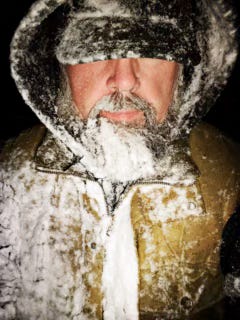
Cold weather. I love fall and winter and I can hardly wait for them to arrive. The dark time of year is when I feel most alive and it is all just lingering on the near horizon. So long as my heart doesn’t give out in the meantime—literally or emotionally—I think I’m going to make it!
10. If your creative work is a map, where does it lead?
Where we’re going, we don’t need maps. The night sky will tell us all we need to know.